


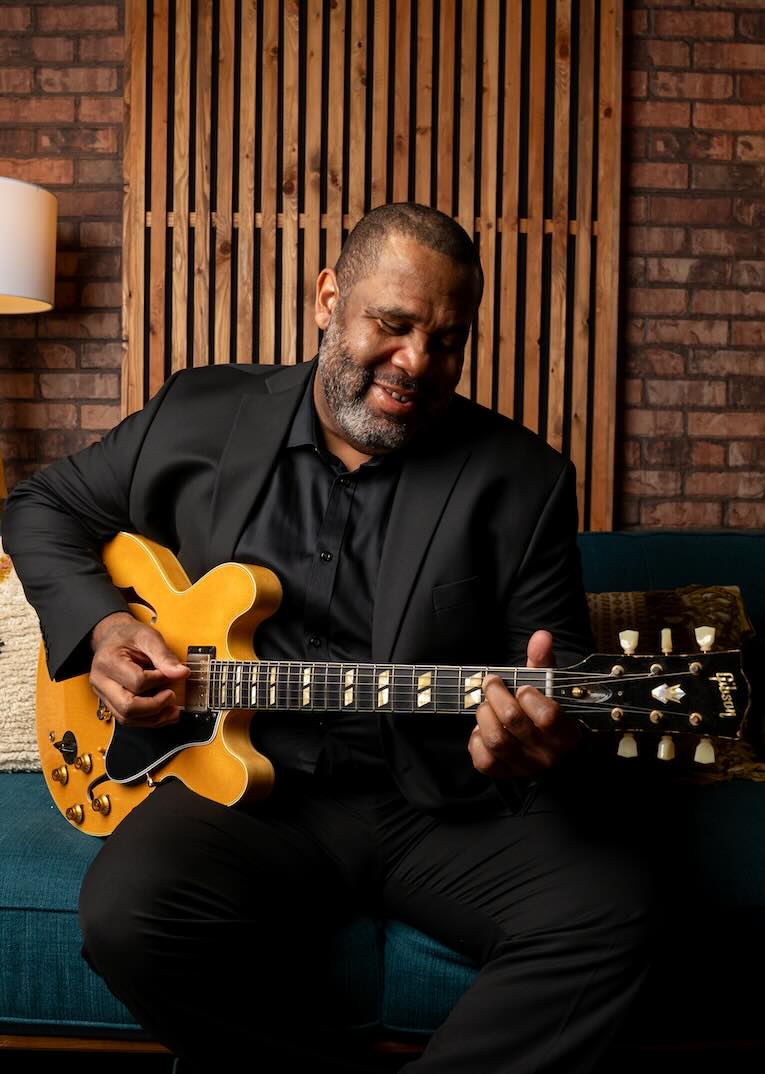
Photo: Steve Rose
Soul Strings: Kirk Fletcher on Life, Guitar Tone, and the Heart of the Blues: Interview
By Martine Ehrenclou
Blues guitar hero Kirk Fletcher is regarded as one of the greatest players in the world. It’s not about speed or flashy fretwork for him—it’s about guitar mastery and deep-rooted soulfulness. After he built a foundation for the blues growing up in his father’s Compton church, Kirk launched into performing and recording with an extensive list of iconic artists, from Pinetop Perkins, James Cotton, and Hubert Sumlin to Joe Bonamassa, Cyndi Lauper, Robben Ford, Kim Wilson, Charlie Musselwhite, The Mannish Boys, The Fabulous Thunderbirds and many others. With his solo career, Fletcher is regarded as one of the most soulful and masterful guitar players of our time.
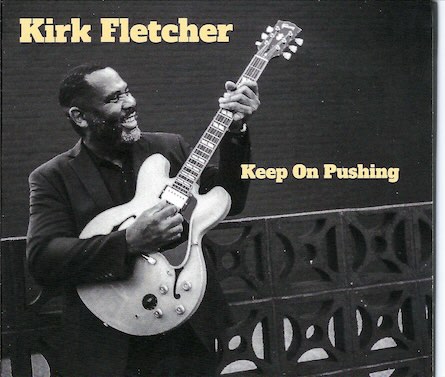
After suffering a stroke on stage at Tennessee’s Eastside Bowl in July 2023, the world celebrated Fletcher’s return with his seventh new solo album, ‘Keep On Pushing’. And he is in peak form. Fletcher’s new album is a rediscovery of his early love of old school blues, co-produced by JD Simo. He has not missed a step. Along with releasing a new album, Kirk is touring the globe, playing several countries across Europe and in the US at major blues festivals, across the map.
Rock & Blues Muse
Congratulations on your new album, ‘Keep On Pushing.’ It’s a great one.
Kirk Fletcher
Thank you
Rock & Blues Muse
How did you connect with JD Simo and decide to co-produce with him?
Kirk Fletcher
For many years, I had a jones to do something a little bit more direct and raw and live in the studio. I was listening to one of JD’s recordings that he had recorded himself and I go, “Man, that’s the sound. I want to do a bunch of covers and have that sound.” I called him up and he said, “Okay, we can do it. I know who to call.” Because he knew everybody in Nashville. His buddy Joe McMahan, who lives in East Nashville, he’s like a tone guru. He has all the old vintage equipment, vintage amps.
Between JD, myself and Joe, it was an absolute pleasure to record. And then we got two guys, Ron Eoff and James Schmay to play bass and drums and it was really cool. This was one time where I didn’t have any pressure. I didn’t have to try and fight for getting my way on the recording or anything. Everybody was like-minded and there for the same purpose.
Rock & Blues Muse
This album has a different vibe than maybe your last couple of albums, ‘Heartache By The Pound’ and ‘My Blues Pathway.’ Can you tell me about the vibe you were looking for? You mentioned that you wanted that sound.
Kirk
The natural sound of the room. For one, natural sounds of everybody playing all at once and sounds bleeding into other things like they used to do in a lot of classic recordings. Just the sound of my amplifier in Joe’s kitchen inspired me to play. I plugged straight into the amp and I heard that sound through my headphones and it inspired me to play a certain way. Tone is so important to the way that you play and attack the guitar and it inspires you so much. Being able to have that great tone from the start was such an inspiration. For instance, if you’re playing like Robert Lockwood Jr. or a lot of these old blues artists, even early B.B. King. He played with this real ambience like you hear the room as well as the guitar.
The guitar tone, when you listen to Jimi Hendrix or whoever during that time, you could hear the guitar coming through the drum mics and that makes it sound a lot bigger. It seems like a lot of people don’t like to record that way and I think it’s a lot of fun. And I got it from the old records. Jimmie Vaughan has mentioned that in a lot of interviews from the ’80s and stuff, just that ambience.

Photo: Mitch Conrad
Rock & Blues Muse
That’s what drew you to JD Simo to co-produce?
Kirk
I listened to a lot of his records. Plus, JD is a freak like I am about the music and the sounds and the tones, and I knew that he’d be a good person to hang out with and record and have fun with because he knows already what I’m looking for.
Rock & Blues Muse
In the press information, you said that this album is a positive message in these uncertain times. Can you elaborate on that?
Kirk
Yeah. The positive message is, for me, just to keep on pushing, and no matter what, just to keep going. A couple years ago, I suffered from a stroke in Nashville on stage. And really, when I was able to see that I could still play music, I looked at music in a whole different way. I’m like, “Man, I got to keep on going. The most important thing is blues and blues music and being able to write my own songs.” The music is most important, not the business or traveling and all that, but the pure love of music is the reason why I started.
In these uncertain times, we all know that it’s difficult for a lot of musicians to find ways to play live. And with all the politics, which I don’t want to get into, (laughter) but just the way things are so uncertain. “Which way are we going? Is blues going to be as important, is live music going to be important? Is humanity going to be important in the next 10, 15 years?” And when you have kids, you think about all these things.
Rock & Blues Muse
You said that after you had the stroke that it changed your point of view about the music. Can you tell me a little more about that?
Kirk
Musicians oftentimes get so jaded about playing music and all the things that you have to do to be a musician in today’s times. You have to do self-promotion, put out your own albums, be your own booking agent, all these things that go along with playing music. And I would really stress about all of that, trying to stay afloat, being a musician.
I think that’s the real thing right there. It’s like, after that (the stroke), I didn’t even know if I was going to be able to play guitar anymore, because when I was in the hospital, someone brought a guitar and it was like, Wow, I was struggling to even play a bar chord. It was all in my mind, thank goodness. I think there was a certain amount of mobility that I had to regain to be able to play at least as well as I can. And I do feel a little bit of mobility issues and, but it’s getting better with each day.
Rock & Blues Muse
That’s excellent. Congratulations. It sure shows on this album. Seriously, amazing. Do you think that your guitar style is different on this album?
Kirk
I definitely do, and that’s largely because of the tone and the equipment that I’m playing. I got to play to the sound. For me, with blues guitar, I wouldn’t necessarily play a certain way with that kind of tone. It’s a matter of taste and doing it so long. I think that’s the fun part of it for me, “What can I do inside this style that sticks with the way I’m playing but yet be myself?” “Let’s change it up a little bit.” And that’s me having fun. In my own way. It was blues guitar because I’m such a fan of it from all the different eras. And we know I love string bending. (Laughter)
Rock & Blues Muse
(Laughter) Albert King influenced you quite a bit.
Kirk
Oh, absolutely. (Laughter) I found on this record, I should maybe shy away from that to give it its own speed, get in touch with some of my early traditional blues influences, that older style coming from the early ’50s, late ’40s style.
Rock & Blues Muse
When you wrote “Croke,” did you purposely write it in this style, or did it just come?
Kirk
(Laughter) Oh, I wrote that melody many years ago. When I was playing a lot more traditional blues, I wrote that melody, but I never officially put it on a record. I played so much jump blues in my formative blues years that I thought it would be appropriate to add on this and a fun thing to revisit and play in that style, that jump blues style, early West Coast. It’s the more bluesy side of jazz, but it’s swinging. It’s more into swing and jazzy blues. It’s more jazzy in the attitude and the execution than it is the notes.
Rock & Blues Muse
I also love the title track. “Keep On Pushing.” Great rhythm and beautiful guitar riffs and solos.
Kirk
Thank you. Writing the traditional straight-ahead blues is one of the hardest things you can ever do, but I wanted to keep it positive. And I always like to write songs that have words that they would’ve used to maybe back in the ’50s or ’40s. I think “Keep On Pushing,” that’s almost something you would say in the ’60s. Because time waits for no one, I got to keep on moving on.
Rock & Blues Muse
Who are your guitar influences?
Kirk
I’m a split personality kind of person. I am the Kirk Fletcher that’s super West Coast, Larry Carlton, Robben Ford with a little BB. And then I have the real Chicago blues side and I’m trying to marry those two things. But I would say, on the Chicago thing, it’s all the westside guys. Magic Sam, Otis Rush, Buddy Guy. Well, Buddy Guy is from Louisiana, but I still consider him a Chicago guy. Earl Hooker and all these guys as well as the Eddie Taylors, Muddy Waters, Luther Tucker–the sound and the pulse of early Chicago Blues as well as the West Coast thing. That’s been what always come back around in my playing.
Rock & Blues Muse
You mentioned the guitars that you played on the album. Can you tell me about them?
Kirk
I played Joe McMahan’s Gold Top Gibson Les Paul with P-90s. It was a reissued guitar. From Joe McMahan, the guy that helped engineer and mix the record. Something about that guitar in that amp sounded so good to me. And then I used also a Gibson ES-5 on a few tracks loaned to me from Joe Bonamassa.
Rock & Blues Muse
Do you have a favorite guitar when you perform or play?
Kirk
I would say my Gibson Custom Shop ES-345. That’s probably my favorite guitar.
Rock & Blues Muse
How did you get into playing guitar? You were raised in your father’s church in Compton.
Kirk
My older brother played guitar, and I wanted to be like him. I picked up the guitar in my father’s church. Once I figured out I could actually get a few notes out, it inspired me to keep going. When I started messing around with the guitar, I didn’t care if I could play it or not. I felt like I had already played before I could actually play.
Rock & Blues Muse
You mean, it was like second nature?
Kirk
It was almost like I had already done that before, if I can be so weird. (Laughter) Predestined to play guitar.
“Keep On Pushing”
Kirk Fletcher Website
What a great interview! Long time fan of Kirk, and looking forward to him Keeping On Pushing for many years to come!