


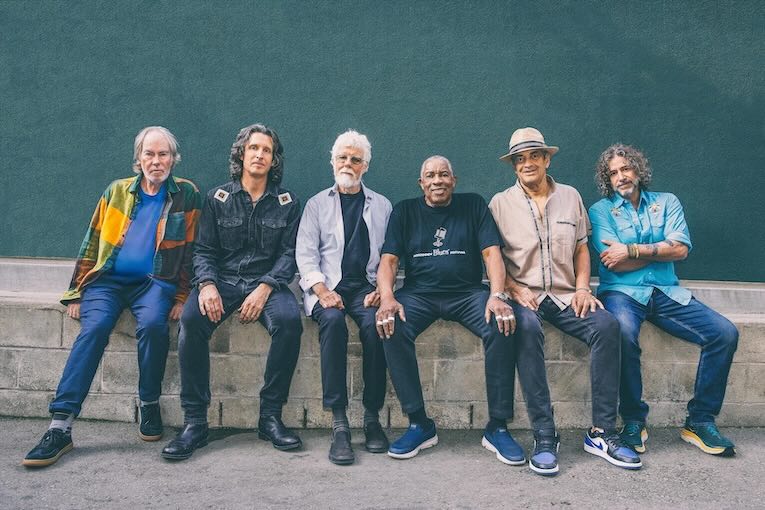
Photo: Fletcher Moore
By Simon Green
In addition to being a founding member of the legendary band Little Feat, Bill Payne has had a stellar career as a session player and collaborator working with such names as Bonnie Raitt, James Taylor, Bob Seger, Stevie Nicks, Robert Palmer, JJ Cale, Emmylou Harris, the Doobie Brothers and many more. Little Feat are about to go back on tour, on the back of their release, Strike Up The Band, heading over to the UK and Europe before coming back and continuing the tour in the States. Speaking to Bill over Zoom as he sat in his house in Montana, with mountains showing through the window behind him, I began by asking what he has been doing in between tour dates.
Bill Payne
I’ve been writing a book at my desk right here, to be called Carnival Ghosts, which I have to deliver by next March. I don’t throw anybody under the bus, but I am truthful without hurting people. Simon, I have these notebooks I use – holds one open to the camera – they’re notated with details of who I’ve worked with. I had a lot of meetings, a lot of sessions. This one’s from 1984, when I was in Australia. Around that time, I was working with Stevie Nicks, Jackson Browne, Bonnie Raitt, James Taylor and on and on. That was a whirlwind back then.
Rock & Blues Muse
Did you find those sessions exciting or, as a veteran musician, was it just a professional job?
Bill Payne
The music and the personalities makes it exciting; it isn’t always, but generally it is. That’s why I’m writing this book, it’s documenting not just a prolific time for me but for music in general. Lowell George passed away on June 29th, 1979. I then started what I call my time in the wilderness, which started in 1980, which is when I began working with Linda Ronstadt. A year later I started working with James Taylor, while still playing with Linda; I did a tour with Jackson Browne in 1980. I did the “No Nukes” concert with Bonnie Raitt and others. There was a lot of music being played.
Rock & Blues Muse
A lot of the musicians who worked with the people you mentioned seemed to circulate among them, almost like the Wrecking Crew.
Bill Payne
That’s a good point. We followed the Wrecking Crew. I’ve spoken to Fred Tackett (Little Feat guitarist) about this before. We worked with people who were in the Wrecking Crew who were still active in the 70s when I first started doing sessions. I write about playing with Earl Palmer in the book. I didn’t realise it at the time, but he played drums with Little Richard on all his records, like ‘Slippin’ And Slidin’’ and Tutti Frutti which I adore. That energy you feel when you hear those records is still intact.
Rock & Blues Muse
How is your energy these days, you seem very active?
Bill Payne
I think about it; I’m seventy six and still playing music of a very high quality, still having fun doing it and loving it; that’s a testament to what music means in my life still. I don’t have arthritis and can move my hands. My energy when I play live is not the same as when I was twenty one, but people still ask, what are you on? It’s not about age when you play, it’s about who you’re with and what you’re doing at the time. I’ve gained rather than lost things over time, which is the main thing.
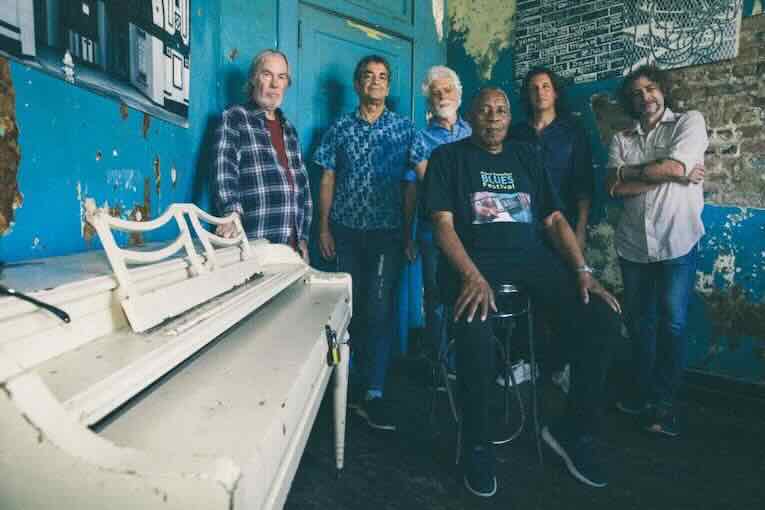
Photo: Fletcher Moore
Rock & Blues Muse
You must have picked up a rich musical vocabulary over the years from the experience of working with so many musicians?
Bill Payne
Well said, it is a vocabulary. The other thing I’ve got going for me is something taught me by my music teacher Ruth Neuman, who passed away when I was fifteen. She said to me that you won’t always have a keyboard with you so use what’s in front of you, your lap, a desk, to visualise the keyboard. I’ve done it all my life. I don’t practise a lot specifically, although I do for piano nights in New Orleans. Generally, I’ll sit at my desk and move my hands to imitate piano chords and hear the music in my head. Ruth was able to guide me, until the age of fifteen, through the musical walls you can encounter. She was like a mother to me. She said to my mother, I’ll make sure to teach Bill how to read music but let’s not take the magic out of it for him.
Rock & Blues Muse
A quote on your website is to the effect that being inquisitive is the way to stop from becoming stagnant. Is that your philosophy?
Bill Payne
It is. It’s not geared to any one age. If you’re inquisitive it will take you places where you can realise your dreams. Music and friends, food, literature, what you read, all of these are important to leading a healthy and an interesting life.
Rock & Blues Muse
Your site also mentions that you work as a commercial photographer. What does that involve?
Bill Payne
It’s mainly that I would take photos and I’d put them on the site and people would ask to purchase some of them. In my book I’ll take 8-10 photos and describe what they mean and what led me onto my journey to become a photographer at the age of fifty. I treat it the same way as I treat playing piano and music, seriously – but I have serious fun doing it.
Rock & Blues Muse
What happened in the period between learning music as a teenager and later joining Little Feat; did you play in bar bands?
Bill Payne
Absolutely. When my teacher passed I got into trouble because I drank too much one night with a friend of mine down in Ventura, where I used to live. My parents came to pick me up the next day and they told me that the parents of someone from school had called to say their son was putting a band together and wanted me to audition for it. I went along and auditioned as a drummer (laughs)! They happened to have a piano there which I opened and started to play. They didn’t know I played. After they heard me play they said, forget this band, we have another one down the street you can play piano for. I’ve been in bands since the age of fifteen. A few in Santa Maria, some in Santa Barbara. I knew this guy called “Buffalo” Bruce Barlow, who played with Commander Cody and also with Magic Sam – he later auditioned for Little Feat before we went for Roy Estrada. I thought, if Bruce is out there playing, maybe I should be too, which led me to listening to Frank Zappa. There was a song on his Uncle Meat album called ‘King Kong’, which made me think, I want to be in that band! I made a phoney calling card and called up Zappa’s record label, Bizarre. They said Frank’s going to Europe but there’s a guy called Lowell George you can speak to, who I contacted. The story’s more complicated than that, but I’ve cut to the chase! It was a natural journey, but one with a lot of pitfalls. It’s an interesting tale, which is set out in Carnival Ghost.
Rock & Blues Muse
Did you keep detailed diaries going back to the sixties?
Bill Payne
I probably started around ’71, so I didn’t capture the start of Little Feat. One of the problems I have is that I used shorthand. As an example, in one of my books I had sessions recorded as “Bonnie” repeatedly. It took me a while to remember that I worked with Bonnie Bramlett as well as Bonnie Raitt. Sometimes I would just put something like, “working with Glyn Johns in the studio”. I was looking at that yesterday tyring to remember who the artist was. There’s a lot of cryptic clues in the diaries (laughs)! I’m looking here at 11th August 1987, I was working with Toto producing an album called The Seventh One, with George Massenburg. When I write about events I don’t necessarily do it chronologically; to explain the legacy of Little Feat I jump from 1972 to 2021, when we got Scott Sharrard (on guitar) and Tony Leone (drums) in the band. I wanted to describe who they were and when they started listening to Little Feat. The book is about how a band retains its identity through
a lot of iterations.
Fred (Tackett) was hanging with us in ’72 and he also played on Dixie Chicken, on a couple of songs that he wrote, although he didn’t join until 1987. We played a gig with the Nitty Gritty Dirt band recently and Fred and I were talking with Jeff Hanna about the beginnings of our journey. Fred had this amazing tale about how he came to LA, which involved a touring Filipino band and staying at Jimmy Webb’s house. The housekeeper there had a daughter, Patricia, who visited. Fred fell in love with her and they married (and are still together). Patricia lived next door to a guy named Lowell George. Fred met Lowell when Jimmy Webb asked Lowell to play sitar on something for him. It’s a Dickensian tale. It’s good to document what happened.
The Yardbirds story was one of the impetuses for us to put Little Feat back together in ’88. I saw the Yardbirds in ’67 at the Rose Garden in Pismo Beach. We went there to see Jeff Beck, who wasn’t on stage. We’re shouting out “where’s Jeff?” and then we heard Jimmy Page play, and it was great stuff. You can’t replace Lowell George but if you still sound like Little Feat you can capture the majority of people, which is what we did.
One of the things that defined Lowell George as a human being was his vulnerability, which led to his problems with taking too many drugs and drink. At heart he was a brilliant person, and his death did not define who he was. Even when he wasn’t writing a lot of music for Little Feat, he was still writing songs like ‘Long Distance Love’ and ‘Mercenary Territory’, wonderful, wonderful songs. He was also bringing in material like ‘New Delhi Freight Train’ by Terry Allen, a Texan. Nobody took anything away from him. Paul Barrere and myself were asked to get involved in songwriting because he was doing less. What struck me about Lowell was that, even when he was compromised, he was a formidable musician. His vocal phrasing and his slide playing were both impeccable. He was a hell of a musician, but he was a troubled guy and very vulnerable to a lot of things.
Rock & Blues Muse
What was behind bringing Scott and Tony into the band in 2021?
When Paul Barrere passed away in 2019, we had to question whether we should continue or not. I love playing Dixie Chicken, which keeps it fresh. However, I wanted to have new music for the band as well. When we started up again in ’88 we had Craig Fuller; Shaun Murphy also was a great addition to the band for a while. Every iteration we’ve had of the band has had its plus points. You keep it going through musicianship and your ability to write songs. I think that’s what defines Little Feat: the ability to have great musicians, to have or not have horns; a slide sound is endemic to the band; a rhythm guitar player and keyboards , same thing. Ritchie Hayward was one of a kind; however, Tony is like Ritchie in that he plays very melodically. It’s quite the talent. Sam Clayton holds it together on congas. Kenny Gradney on bass is just ridiculously good.
Rock & Blues Muse
I read that you wrote around twenty songs with Robert Hunter (lyricist for the Grateful Dead). Did you co-write all the songs on the album or was that collaboration a starting point for others to chip in?
Bill Payne
I had written most of the words for the opening track ‘4 Days Of Heaven 3 Days Of Work’ and went to New York to finish it off with Tony and Scott. Scott brought in some songs that he had written and I encouraged Tony to write. I gave him a title I had, ‘Running Out Of Time With The Blues’, which he ran with. He’s a great writer and plays guitar as well as drums. Fred Tackett had some songs, including a new one, ‘Too High To Cut My Hair’, which is about his wife Patricia.
The band hadn’t released any new songs for a while and Strike Up The Band is the first album in thirteen years. Was the addition of the new guys the spark behind the release?
It was the fact that we were starting the band up again. We can communicate with people with the material we’ve done before but to grow your fan base and keep your existing one happy you have to show them what you’re capable of doing now. That’s how it all started. If you shut that part of yourself off, it’s a pretty major thing to walk away from. I don’t want to do that. We still sound like Little Feat when we’re playing ‘4 Days Of Heaven 3 Days Of Work’.
Rock & Blues Muse
Did you consciously try and return to the sound of the earlier version of Little Feat with this album?
Bill Payne
It wasn’t conscious but it maybe it should have been. It was just what we came up with. There’s a couple of jazz excursions on the record. I wrote the last song on the album, ‘New Orleans Cries When She Sings’ with Vince Herman, who’s from a band here in the States called Leftover Salmon. It opens as a ballad and then just takes off after the second line beat, which was a traditional thing with Little Feat. New Orleans is so ingrained in our sound and our psyche. My parents were married in New Orleans although I was born in Waco, Texas, and raised in California, where I was a surfer. There’s a lot about surfing in my book (laughs). Little Feat is, selfishly, a platform for me to play and experiment. I think that’s what music and art should be. You have to produce something that represents who you are as an artist and an individual. I’m surrounded by like minded people that enjoy a cross section of music that blends genres, that blends jazz with country blues, with rhythm and blues and rock’n’roll music. I think music will be a part of my life until I go; that doesn’t mean I have to pretend I’m like Mick Jagger when I’m in my eighties!
Rock & Blues Muse
The album was made at the Blackbird Studio in Nashville, with Vance Powell as co-producer?
Bill Payne
Vance is amazing. He would say can we try this just as I was going to ask him to do the same thing. I weighed in on things, but he was normally three steps ahead. Vance brought in Kristen Rogers to sing with us; she’s on tour with Post Malone at the moment. She’s incredible.
Rock & Blues Muse
How did you approach recording; was everything pre-prepared or was there room for experimentation?
Bill Payne
We went in for a week of rehearsal beforehand, and then went into the studio. We did leave certain things open to see what would happen in the studio, but, for the most part, things were mapped out, particularly for my songs, which are a little more complicated. You need a clear sense of where you’re going with a song, it’s not a debate, although if we can improve on it, great. We recorded for around a week and then did some overdubs. It used to take us much longer to do things in the past. We’re more focused now about keeping it within a budget.
Rock & Blues Muse
You’ve played with so many people. Are there any highlights that stand out?
Bill Payne
There’s a laundry list starting with Bonnie Raitt. There’s a session I did with Michael Macdonald of the Doobie Brothers, where I was meant to play all the keyboards. I asked Michael to play the intro to one song, ‘Minute By Minute’ to show me how it went, which he did. I said I can’t play that, you do it. The same thing happened with the next song, to which I just added some high strings, which was ‘What A Fool Believes’. I did a session in England with Bryan Adams, which was for ‘(Everything I Do) I Do It For You’, which was in the Robin Hood movie. There’s that kind of stuff. I was in the studio with Rod Stewart, although I really met him after the fact. Here’s a funny story to close with: we were at a party in Denver, Colorado that Warner Brothers were throwing for us and for Rod. I said to Fred Tackett, who played on several of Rod’s album, that Rod would be coming. He said, he won’t know who I am. Sure enough, we hear this commotion at the end of the hall and I hear a voice calling out “Billy, Billy” (adopts passable English London accent). Rod comes up and gives me this big bear hug. Looking over his shoulder I see Fred with his arms up, mouthing I told you!
Little Feat website
Leave A Comment